
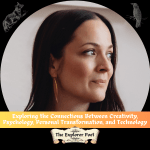
Description
In this conversation, with Nathalie Nahai, we explore the intricate connections between art, music, psychology, and personal transformation. We delve into the significance of creativity as a means of expression and healing, the exploration of shamanism, and the journey of leaving behind rigid religious structures. The discussion shifts to the implications of AI in society, emphasizing the need for ethical considerations and human values in technological advancements. Ultimately, highlighting the importance of hope, human connection, and the potential for positive change in a rapidly evolving world.
Key Take Aways
- Creativity serves as a powerful means of expression and healing.
- Art and music can transform pain into beauty.
- Fiction fosters empathy and understanding across diverse perspectives.
- Shamanism offers insights into personal transformation and healing.
- Leaving rigid religious structures can lead to profound personal growth.
- AI presents both opportunities and ethical challenges in society.
- Human connection is essential for navigating change and uncertainty.
- Imagination and creativity are vital for a fulfilling life.
- Collective agency can drive positive societal change.
- Engaging with nature and community fosters resilience and hope.
Meaningful Quotes
On the transformative power of art and music:
“With music, it was always a way of expressing that which can’t be said in words or sublimating things that are too painful to show up anywhere else in one’s life.” – Nathalie Nahai
On the freedom found in creative expression:
“When you’re a kid, there are a few pockets… where one experiences a sense of freedom and agency and creative expression. And it was, it was a sense of freedom and play and beauty.” – Nathalie Nahai
On the psychological impact of storytelling:
“Fiction is one of the fastest routes to moving people to a state of openness and compassion and empathy.” – Josh Mortensen
On the collective experience of music:
“With music… there’s something about this kind of entertainment or coherence where all of the rivers start to flow in the same direction. And that’s just wild.” – Nathalie Nahai
On the loss of connection due to technology:
“That’s one of the things I think is being eroded by our constant connection with technology.” – Nathalie Nahai
On shamanic practice as a source of healing:
“It’s a practice that I found to be very useful, deep healing, and has helped often put understanding to things which are non-verbal or pre-verbal.” – Nathalie Nahai
On the emotional journey of leaving a restrictive religion:
“The death was far less painful than the rebirth… because of the betrayal trauma.” – Josh Mortensen
On embracing paradox as part of growth:
“To be an adult, to have grown up, you have to accept paradoxes in your life… but that mystery in and of itself is one of the most exciting things about being alive.” – Josh Mortensen
On the societal risks of AI development:
“My greatest fear is not so much the technology and how quote-unquote, intelligent it is, but… the values and the lack of guardrails and the distorted incentives baked into these systems.” – Josh Mortensen
On hope and collective agency for change:
“There are so many people who are waking up to this and going, hang on, we needn’t be suffering like this. We do have agency and we have collective agency.” – Nathalie Nahai
Guest Details
Described as “a rare polymath with deep expertise in tech and psychology”, Nathalie draws upon a rich background in human behaviour, web design and the arts, to offer a unique vantage point from which to examine the complex challenges we face today. Having studied psychology and worked as a web designer early in her career, she wanted to map out a comprehensive framework through which to understand online behaviour – a process that culminated in the publication of the international best-seller, ‘Webs Of Influence: The Psychology of Online Persuasion’.
Website: https://www.nathalienahai.com/
Flourishing Futures Salon: https://www.ffsalons.com/
Art + paintings: www.nathalienahai.art
Youtube: https://www.youtube.com/@NathalieNahai
Podcast (Apple): https://podcasts.apple.com/gb/podcast/in-conversation-with-nathalie-nahai/id1387510537
Podcast (Spotify): https://open.spotify.com/show/4Pfgbtg1AQnlbAaMeAUFJj?si=cc1076ec005a4f7e
Where to find The EXPLORER POET Podcast
Speaker 2 (00:03.564)
Natalina, hi, welcome to the Explorer Poet Podcast.
Thanks for having me, it was nice to be talking with you, Josh.
Yeah, absolutely. It’s already been fun just starting to get to know you, but I think that you and I have a ton of different, I don’t know, different subjects that we’re both interested in. We have a lot in common about kind of the things that we like to explore. And while you obviously, you you write books and you have a podcast and you’re interested in technology and psychology. The thing that jumps out to me, especially on your website, when you describe yourself,
The first thing that you talk about is actually about art and music.
It is now.
Speaker 2 (00:42.986)
Yeah, so I maybe I, yeah, I like the idea of somebody who’s such an explorer and all these ideas and these different realms. But at the same time, you obviously have some kind of a passion or an interest or desire to create and be creative. And I just find that really interesting that kind of the interplay there between psychology and creativity, psychology and art. So I just maybe want to start by asking you, you know, where
Where does all of this start for you? Where does this interest in creativity and art and music, where does this all start for you? And then how does it connect to this broader kind of idea of psychology?
Yeah. So nice to be asked this question, because usually everything starts from the behavioral science persuasive tech angle, which is fascinating, but less soulful much of the time. So with the with the arts and the music, ever since I was really little, I would draw. And when I was angry, I would express myself through, through drawings, my mom and my dad took me to art school. Well, I suppose it was it was like a weekend art class on Sundays. And
I remember the smell of oil paints and my teacher called Pat Hoodmon, who was amazing. And we’d go in and she’d give us these little, in the UK there, these little kind of caramels of chocolate in the middle called chocolate eclairs. I have a massively sweet tooth. And I’d go in and it’d be smelling of oil paints and you get to paint for however many hours and have your little chocolate eclairs. And it was just this moment of joy that was just completely…
completely untouched by having to behave or, you know, sit up straight or X, Y and Z. You when you’re a kid, there are a few pockets, I think, well, for me, at least one experiences a sense of freedom and agency and creative expression. And it was, it was a sense of freedom and play and beauty. And I think there’s something about, because I’m quite, I don’t know if I’ve always been restless, but I think there’s something about
Speaker 1 (02:45.538)
the act of focusing deeply on something which is changing before your eyes, that is deeply focusing and I suppose meditative as an adult maybe having that language, but you’re just in this flow state. so I think art has always been something which has been there for me. And then the music came from a very young age. was raised on Suzuki violin, which is where you learn by ear. So my theory is shot to shit, but I can really learn music quickly and I’m really…
proficient in harmonies because you learn everything from the age of two. I started when I was two by ear. So you’d hear all the older kids playing Twinkle Twinkle Little Star and they’d do all these variations and then you’d be playing the Bach double when you got good enough. And so with the music, it was always a way of
I suppose expressing that which can’t be said in words or sublimating things that are too painful to show up anywhere else in one’s life. I think, so for me, the music always had a transformative quality of…
being a vehicle is not a very useful word, but like being a river for something which was needing to be expressed and to transform something that was often painful into something useful. And so then I was going to go into, first I was going to go to art school and my parents were like, well, why don’t you do something actually not dissimilar to what you described before we started recording? You you look at the job market and you think, which is going to be a good bet? What am I intellectually capable of? Where can I place my skills so that I’ve got some kind of protective?
or wise path forward to be able to sustain myself financially and for you that was accounting and for me it was psychology. And so I did psychology degree, it was fine and then eventually went to the States at Atlanta, Georgia to record a couple albums. I’d learned guitar by then, sort of taught myself and was doing folk music. And I mean maybe we’ll park the story there because I could go on but yeah, was kind of, it was quite a journey and then switched.
Speaker 1 (04:47.502)
when I was 25 to a more sensible, probably not that much more sensible, but more remunerative, easier career path than music as a woman playing folk aged 25. Put it that way. More investable.
Yeah, more practical, I guess, from an economic standpoint. Unfortunately, that was my whole reason for going into accounting was just it was practical and I needed to provide. Looking back, probably should have, if I had picked psychology, thinking that that could be practical, probably would have been, I don’t know, a more aligned path for me. But I think what you say about music is very interesting. You said it’s a way of sublimating the…
I don’t know, it’s the internal, whatever you’re feeling inside and putting it out in a way that, that you said it doesn’t even need to be expressed with words, but I can really relate to that even though, you know, as a writer, I’m constantly using words, but it’s not like, it’s not like as a writer, I want to just say specifically what I’m trying to get across. I want it to be creative and I want to hide it in a story and make it feel a little bit more like myth and.
There’s something about art and creativity in that sense for me that is extremely healing and extremely, you know, it just helps you get stuff out that you’ve struggled with perhaps. And yeah, I find that anybody who really throws themselves into that creative process gets that benefit.
Yeah, yeah. And I think also there’s something about, you if you’re creating a story, which is compelling, of course, we’re using words, but we’re using words to paint something into beings. That’s kind of you’re transporting someone into a different world or situation. And with a kind of psychology hat on, there’s plenty of research that explores how one of the most powerful and effective ways of shaping someone’s perspective to towards people that might feel like they belong to quite a different group.
Speaker 1 (06:39.534)
terms of religion or values or the way that physically they present however, know, whatever thing you can think of, that fiction is one of the fastest routes to moving people to a state of openness and compassion and empathy. And there’s something really extraordinary about that, that you can just use a dead tree, pummel it a little bit, put it through a process and then use ink to make someone vividly hallucinate for the length of time it takes them to read your book and put themselves in someone’s
world and then feel differently afterwards. I mean, that’s, it’s quite nuts, don’t you think?
Yeah, yeah, absolutely. is nuts. There’s that quote that gets, you could live a lifetime, one lifetime without reading, but with reading, you can read endless lifetimes. And it really is interesting how you can experience that. You could be transported to different times and places. And okay, so this is a little bit tangential, but I have this idea of around what thoughts are in your head anyways, being that…
you we’re not our thoughts. We don’t actually control our thoughts entirely. They kind of just come to us. And so in a lot of ways we can associate with them, but in reality, they’re, I almost think of thoughts more as some kind of abstract sense organ, where if your eyes are giving you, you know, a more concrete picture of what the world is, your thoughts are actually a similar sense organ. just a little bit abstract. And so rather than seeing things for what they are, they’re saying, what if this or what if that?
If that’s the case, and thoughts are just some kind of stream that we experience as a sense, when you have a conversation like this where I listen to you and you listen to me, or if you write a story, you write fiction, and then somebody reads that, even nonfiction with the books that you’ve written, then what you are doing is in a strange way, you’re tapping into the unconscious stream of another person, which is…
Speaker 2 (08:35.918)
It kind of gives me tingles a little bit to think about. As humans, it’s such a wild experience that we can formulate thoughts and then share them with each other.
But I think to your point about, and I think fiction does this in a way that, I mean, obviously, you know, I write sort of the business side. yeah, but I think fiction, one of the things I think is really trippy and extraordinary about fiction is that someone is reaching through time to your mind to give you an experience that you’ll kind of co-create because whatever you’ve written, no matter how specifically you’ve described a scene, we all bring our own flavor and senses to bringing it to life. But when you think about
ways in which perhaps, you you would have written a book at a particular time, maybe someone reads it a week later. So it’s that temporal asynchrony, I guess. But imagine that’s lifetimes that you can reach through time, the same thing with music, but to read the words that someone’s lifetimes ago, and to be able to kind of go back, I just find it’s really quite extraordinary to time travel like that. And I think with music, it’s it’s almost a different thing in the sense that you’re talking about the river of stepping into someone’s kind of o’er.
I guess beckoning to their subconscious, to their river, to their experience. And I think with music, what’s curious is that you’re then doing that if you’re with a group with several individuals, sometimes crowds of thousands. And there’s something about this kind of entrainment or coherence where all of the rivers start to flow in the same direction. And that’s just wild. I don’t know you’ve ever had like, there’s been a few times in gigs, especially the more intimate ones, where there’ll be this space that just opens up and you can feel it. It’s like a
I’m quite visual, so I experience it as like a visual thing, but also a somatic thing. It’s almost like an orb opens up in a space and there’s this silence that falls between the notes, between the voice singing, and everyone’s just suspended in this moment of timelessness. And there’s something so extraordinary about that. And it’s really special. And actually, that’s one of the things I think is being eroded by our constant connection with technology.
Speaker 1 (10:44.504)
But I think fiction can also do that, but it’s a much more intimate, like, you know, you’re not reading exactly the same word on the same page, even if you’re reading the same book with 10 of your mates on book club.
Yeah, exactly. with reading, it seems like it’s much more intimate in the sense that it’s more one-on-one. then what you’re describing with music, the thought that came to me is collective flow, like you all kind of joined into it at the same time. You know, there’s almost nothing more fun than being at a concert of a band that you really love and there’s just thousands of strangers around you and you’re all singing along to the same song. It’s kind of wild.
It is totally wild. Yeah.
There’s the art side and then I want to get to the psychology studies and the work that you do, the technology and all that stuff. But then the other thing that popped out to me was that you mentioned on your website that you’re going through a shamanic practice training.
So you looked at the art website.
Speaker 2 (11:45.486)
I guess so. was clicking around. But that also jumped out to me a lot too because man, do I have like this, I don’t know, this archetype inside of me of the shaman that wants to come out. Or to be honest, sometimes I think it’s more the wizard. There’s a little bit of a difference there. I’m really curious, what is this? What is shamanism and what draws you to it?
I noticed I’m actually feeling quite, what would be the word, slightly edgy. It’s curious because I don’t often talk about this. It’s more of a private aspect, mostly because…
I suspect my internal tension between these parts is also something which is reflected in wider culture. So for me, it’s kind of practice.
Just to be fair, you don’t have to go into it too personally, but maybe you could keep it on a kind of like an intellectual level.
No, I mean, I think it’s interesting to go into the territory that takes you to the edge, right? But thank you for the get out clause. So think, so thinking about the story of shamanic practice, so the word shamanism actually can be traced back to a westernized understanding of a word that was found in Siberia, and then used to describe many practices around the world, which tend to be animist and shared certain traits in common.
Speaker 1 (13:09.774)
And so now when you hear people talk about shamanic practice, often if it’s in a Western context, and I was born in London, even though I have European and Middle Eastern roots, in a Western context, people will usually be talking about the kind of core shamanism as described by this American scholar, practitioner called Michael Hanna, who went for decades to different groups, indigenous groups predominantly in different parts of the world.
and documented their stories, their music, their practices and created a whole library of resources where he was then able to collate and identify certain characteristics or practices that were common between these different communities. So an example might be, to give a broad brush, inducing some kind of altered state. So this could be either through very extreme means.
So putting yourself in mortal danger with the potential of death, which some cultures do. It could be through extreme fasting, or it could be through entheogenic plants or chemicals excreted by animals. It could be through dancing. It can be through communal singing, rattling, drumming. There’s so many different ways to reach these states. And so then he would identify these different states and then started teaching people in the West whose
roots to their own animist practices like in the islands and well in the UK it would have been more Celtic and druidic practices had been stomped out by the Christian Roman invasion. And so there’s it’s a really interesting collection and one of the things that I find tricky about it now is that because we’ve become so for so many generations there’s been such an alienation from
nature-based practices, which is what always drew me in from a very young age, that we, it feels quite fantastical. And yeah, I don’t think it’s any more fantastical than thinking that there is a male figurehead, paternal figure in the sky that, and I was raised Catholic, that will condemn you to eternal flames and suffering because you descended from two humans that were born evil.
Speaker 1 (15:30.67)
I mean, there’s just, I’m reducing this into a very simplistic way. And according to the experience that I had growing up within a Catholic church. But so like, you can pick your story. And I think when it comes to shamanic practice, as I’m a musician, I think it also speaks to me that using drum and rattle into to form a context in which to go in with an intention and experience, what some might describe as like a creative visualization, or I would describe it like a dream or journey.
to then draw insight from that. And for me, it’s where I also draw insight for, or images for my paintings and my music. It’s a practice that I found to be very useful, deep healing, and has helped often put understanding to things which are non-verbal or pre-verbal. Yeah. There’s so much more that we could say about like…
Yeah, it’s a practice that I absolutely adore. And that’s actually where I’m drawing on actually on shows. So can I show you painting? Yeah, of course. So I’m working on a series of paintings that will be exhibited in London next year. It’s actually going to be an art-based but also music and ceremony-oriented exhibition. And this is one of the paintings that I painted from, let turn this down, from one of my journeys. Wow.
The realism is incredible.
So that’s one and then another one would be, it’s basically I do everything in this tiny room, but it does mean that everything’s kind of one or all of them at hand’s reach, but this one, which is a self portrait.
Speaker 2 (17:12.95)
Wow, yeah, it’s beautiful.
So yeah, so that all comes from my shamanic practice. And so for me, it’s a embodied, it’s a really embodied very…
visual and sensory and musical practice.
Yeah, yeah, well, I appreciate you sharing all that because I maybe you weren’t expecting that. So I put you on the spot a little bit, but I appreciate it. I find it all very fascinating. Like I’m a big reader of history in terms of the stories that we tell. And so you talked about the Roman Catholic Church or the, you know, that kind of empirical movement north that it wiped out a lot of the European shamanism and kind of the old Celtic or for me, the Norse type of religions or mythologies, belief systems.
And there’s something very interesting about it because yeah, in our world, and you mentioned this as well, in our current world, is this idea of like multiple realms or the ability to transcend and go into other places, even if it’s in your mind or psychological, but also that there’s wisdom to be found there. That whole part of humanity has really been held back. It’s been put in our shadow.
Speaker 2 (18:29.358)
And yeah, think it’s actually, it’s really unfortunate, this kind of evolution of religion that happens where usually when a religion springs up, it really benefits a lot of people. But over time, it comes to be more of a kind of controlled system. And there’s like a priestcraft involved. And it does seem that the world could benefit.
from some people who can help others kind of get into these spaces. You know, for me, I’ve arrived in those kind of, those other realms or those other spaces many times, and as you mentioned, through many different means, you know, through music, through meditation, through drugs, and the things that I’ve learned there have been so enlightening for me and so helpful that I…
I almost can’t imagine being the person I was before I experienced them because I was so blind to so many things. And I think that our Western world does suffer from that greatly.
Yeah, and it’s, it doesn’t, it pains me because I think it doesn’t have to be this way. Like I recently went to, ended up going to an artist retreat, a Zen Buddhist community called Plum Village in the south of France. And I’m having been raised in a dogmatic, fairly authoritarian religion. I was not a fan. I’m not a fan of that kind of structure. I have a deep distrust of authority and a dogma.
I have a similar background in this case. I was not Catholic, I was raised Mormon.
Speaker 1 (20:01.272)
Yeah. you actually? Were you raised Catholic?
Speaker 1 (20:06.354)
wow. That’s all I mean, that’s got its own very strict.
Yeah, so very strict and, you know, very kind of by the book, but that’s an interesting conversation. We don’t have to go into it, but the comparisons between Mormonism and Catholicism, the differences and the similarities, but sorry, go ahead.
No, like, hang on, because this is very, so one of my one of my good friends now, he was a philosopher, escaped. Well, I don’t know if that’s the word he would put, I think it is, was also in a very strict Mormon community. And one of the elders gave him a book.
that then allowed him to get some answers or more questions to some of the questions that they weren’t allowed to talk about and he ended up leaving the community. I’m very curious how, if you have left, I’m assuming based on how you’re describing it, how you did, how you came to leave. Because it can be difficult.
Yeah, it was difficult, but I would say that there’s two pieces to it. So there’s the emotional side of your life, and then there’s kind of the rational sense-making side of your life, and that applies to religion as well. And so I grew up in the religion in such a way that it was really all I knew. I was homeschooled, we lived in the country, and almost any of the outer world, what that was for us was church. And so our community was the…
Speaker 2 (21:27.912)
other members of the church. The kids that I was allowed to play with were other members of the church. It took a long time to get any kind of historical context for why this may not be the one true religion for me. But all along, there was always an emotional discomfort and this emotional dissonance with the place I was in the world. There was a point in my life
when I was maybe in my early thirties, my wife and I, we had been talking for a while, maybe even a couple of years about kind of this discomfort or this dissonance that we were feeling. And we both kind of just started exploring just a little bit into some self questioning about like why we always have to turn to the church rather than trusting our own instincts or our own intuitions. And then,
What really happened was I came across some podcasts that were about Mormon history. And the thing about reading stuff that’s not sanctioned by the church is that it’s often called anti-Mormon. And so there’s this idea that if you don’t read stuff, if you read material that’s not sourced from the church, then it’s gonna have this intention of helping you lose your faith and it’s gonna be full of lies and slander and whatnot.
So I started, I started actually listening to these podcasts and what I found was that this wasn’t anti-Mormon at all. It was just primary source material. So it’s like letters and diaries and journals. was newspaper articles and court cases and arrest filings. And so it’s just like, it’s just not, it’s not fiction at all. It’s just the documents. And once I paired a more complete understanding of the church’s history and kind of the
the evolution of the church and the evolution of the doctrines. Once I paired that with the emotional dissonance that I was always feeling, was actually very easy to walk away. It’s like this.
Speaker 1 (23:33.144)
But both of you walked away. You had a partnership that you could actually
Oh yeah. Yeah, we were very fortunate in that way because we both were ready to leave. Yeah, yeah, she was actually a little bit more ready than I was at the time and I’m really grateful for that because a lot of people don’t end up with that and it can be very difficult for a family and for a relationship. yeah, especially for the person who stays, they’re just completely lost as to why the other person lost their faith. But what I would say is…
Yeah.
Speaker 2 (24:04.15)
I don’t know, of hearkening to the shamanic realm or the shamanic practice side of things. In Joseph, in one of Joseph Campbell’s books, he talks to a shamanic like figure who lives in, I want to say in Canada, or maybe he’s quoting somebody who spoke to him. And the man, the kind of the native shamanic man says that in order to be a good shaman, you have to die at least once. And then
In order to be a great shaman, you have to die at least three times.
Let’s just say for the record, I am not a shaman. have a practice that uses… I think, you know, I have in my lifetime met… When I was 21, I met someone who was really deep in that tradition in a Quechua community in Ecuador, was doing some voluntary workout in the Amazon basin to learn about actually how to reforest. Well, it was more like agriculture without deforestation, but included some deforestation and got invited.
Yeah.
Speaker 1 (25:05.378)
there you realise, I mean, and this is, again, thinking about context, people live their entire lives in a practice of apprenticeship and learning. And he was teaching his son, he was in his 50s, his son was in his 30s. And, you know, the term shamanic has an interesting history to it. But it’s, I think there’s, there’s a great distinction between someone who is a master in an ongoing lifelong apprenticeship.
versus someone like me who has found certain tools to be deeply helpful towards healing practices. But I’m an apprentice to the arts and the music. That’s been my lifelong pair of teachers and the psychology. yeah, I just want to flag that right up.
Yeah, we won’t we won’t try to claim that you’re a master, but you’re at least an initiator. You’re there. Yeah. My whole point in sharing my whole point in sharing that though is that you have to die to certain things throughout your life. You have to give them up. Yep. And really what that often means is not physical death, obviously, but the stories that you’ve based your life on, they crumble and you realize that you’ve you’ve fallen and you’re dead.
to that story or that story’s dead to you. And what I would say is that in leaving a religion for me, the death was far less painful than the rebirth, than coming back. Because coming back means, you know, it’s very, when you, I don’t know what your experience was with the Catholic Church, whether it was, it seems like you’re anti-authoritarian systems or institutions now, so you probably have, you had to step away at some point. But for me, growing up in the world that I grew up with,
well.
Speaker 2 (26:49.434)
that I grew up in homeschool in the country with this very strict religion that we practiced on a day to day basis. We did everything that we were supposed to be doing. What happens is when you lose, for me when I lost that religion, I also had a lot of betrayal trauma from like all the, just the lies that had been told to me or the stories that I’ve been made to believe and the things I was made to believe about myself and the stuff that I had to give up. But in a real sense that,
religion and that way of thinking was the infrastructure on which I had constructed my entire view of reality. And so in a real way, it’s easy once you step away from something like that to fall into a kind of Nietzschean nihilism where you don’t trust anything ever again, right? Because the roots are deep. Yeah. Yeah. And then once you see the patterns in one institution, it’s really easy to start seeing the patterns in other institutions.
So that’s why I would say the rebirth is more difficult. I had to start from scratch trying to understand the physical world, the psychological world, the emotional world, relationships, everything. And so in a real way, that’s how I got to where I am now is having this conversation with you is because I just started reading so much and listening to so much. And then at some point I was pretty interested in having these types of conversations with people who have also done the same, the same type of explorers and seekers.
It’s interesting that you mentioned the, I mean, it’s so much interesting what you just said, but the word betrayal, because it’s something that often
It’s such a potent experience, the feeling of having been betrayed. And by people who don’t believe that they’re betraying either. Often these are people with really compassionate intentions or who perhaps haven’t examined the full extent of their beliefs and actions on people who might have left in trying to talk. But I think there’s something really, really poignant about that quality of betrayal. then…
Speaker 1 (28:52.76)
How do you come to terms with that in a way that allows you to not stay in the nihilism and to actually find a way to feel into that abyss and then find some form of light that leads you on? And I think for many people that starts to come from perhaps it’s another partner that you’re working with, walking with, but also from oneself. And I’m curious with you, when you were going through the rebirth, kind of finding your feet, finding your world.
What were points of light or points of hope for you that helped you to orient yourself?
Yeah, now it feels like I’m on your show.
I’m sorry, this is not the territory.
No, no, that’s okay. I enjoy it. This is fun for me. Yeah, it’s interesting because for a long time, I still had a family. I still had a wife. I still had responsibilities. I still had a job. And so in the evening, I was reading a lot and I was listening. If I was in the car at the gym, I was listening to podcasts and conversations. And then in the evenings, I would go for long walks and just think about stuff. And I just started to kind of piece some things together.
Speaker 2 (30:03.118)
Yeah, I came to, I guess I came across a bunch of aphorisms or kind of I put some aphorisms or little sayings together that would help me along the way. And one of the things, one of the little kind of things that first got me out of any kind of form of nihilism was this idea that to be an adult, to have grown up, you have to accept paradox in your life. In the same way that when you’re a child, you want such certainty.
And that’s what religion gives to people as well, is this certainty. yeah, as an adult, you have to accept that there’s always gonna be some mystery. And that mystery in and of itself is one of the most exciting things about being alive. And the exploration of trying to find that. And I came to this idea, because growing up as a Mormon, I was told constantly that God cared about who I was and he knew who I was and that he had a plan for me and that I had a purpose and…
Those are all great things to think and feel, but once you lose that institution that’s telling you that, you go, whoa, like, is there anybody, anything out there that actually cares? And so one of the aphorisms I came up with was this idea that, I guess it’s a paradox where to the universe, to the greater whole of the universe, however massive it may be, I’m pretty insignificant. Like there’s no, there’s no like grand plan for me that the universe has. But at the same time on the other side,
or to flip it around, I’m living this life and this is the one life that I know I get. And so what I do with my life and how I experience it is the most important thing to me, because there’s nothing else that I have power over. And so I think something about that idea gave me this spark of hope of like, figuring some answers out, staying in love with the pursuit of the mystery. And then, yeah, over time,
there’s these little gems of wisdom you come across that you could read in a book or hear somebody say a million times, but it doesn’t really sink in until you’ve actually experienced it yourself. And yeah, so yeah, I went through a couple more cycles of dying and being reborn. I figured that from a symbolic perspective, reincarnation seems more astute to me or more accurate than maybe just a single death and rebirth like in the Western world.
Speaker 2 (32:29.39)
But yeah, even, so you were talking about how angry you can be about the betrayal and how much that can hurt, but you were also saying that the people who betrayed you, they actually were doing it with good intention. They didn’t even know they were betraying. Yeah, and so part of it for me, part of getting to a place where I just don’t struggle as much with all these, you know, all of these things is that you, first you’ve got to get all the emotion out that was there before.
to the climb for sure,
Speaker 2 (32:58.69)
that never got out, a lot of that anger and bitterness, let it come out somehow, not directed at other people, but just let it out. But then you get to a point when you realize, everybody’s, everybody’s operating on the same operating system. And so, you know, people just have stories that they interpret as life. They have rights and wrongs that they interpret as the given morality. And
because of their stories and because of their interpretations, they often see past kind of the true gift of what living is. And you have to, at some point, you can’t be angry at people anymore. You have to kind of forgive them or almost even just see how unfortunate it is that they don’t see it themselves.
Yeah. I think there’s something about having gone through several cycles of destruction, renewal, or death, rebirth, that assaults a soul or assaults a psyche. And you can tell when you talk with people, the ones who’ve been through the ring a few times.
Well, you definitely end up in some deep conversation with them, that’s for sure.
Yeah. And I think there is something about a kind of, but it’s one of the things you mentioned, which I think is so, so important, which you, I mean, sort of this, many of the new age spiritualities at different points in its expressions, likes to exile the dysphoric, ugly, shadowy, jealous, gritty, furious, like all of these signs that actually
Speaker 1 (34:36.201)
often quite unpleasant. mean, sometimes rage feels amazing if you’re letting it out and you’re not, you know, actually harming other beings. But there is something really important about being able to actually give yourself freedom to rage and to weep and to grieve. And I think that’s another thing that there are very, there’s a real need for that in so many cultures where, you know, being raised in a British culture, there’s a huge amount of oppression that so many people experience on a day to day level.
that forbids them from reaching in to that shadowy territory and being able to give voice to the things that actually, if they gave them voice, would let them change and, you know, renew. But I also think we don’t really have, and Frances Weller talks about this quite a bit, we don’t really have that many cultural containers for that to be a safe thing to do. I think especially for men, depending on the culture, which is…
an area where I think we could do a lot more to support people in that process.
Yeah, agreed. Yeah, anger is definitely, it’s something that is very interesting in our Western world because it’s it, I look at everything kind of through story and through mythology. And the Western world is seeping with mythology, we might not just we may just be that we don’t see it. But we what we Western what we worship in the Western world is light, we worship the sun, our universe now is our solar system now revolves around the sun.
And what that means is that we worship like consciousness and we worship truth and we worship goodness, you know, because our first parents partook of the tree of knowledge of good and evil. And so that’s what we think we know. And the problem with that is that when you are always looking at the sun, there’s a huge shadow behind you that you never see. And so in our Western world, everything that we don’t deem as light and goodness,
Speaker 2 (36:41.802)
we put into our shadow and anger is one of those things. And so what ends up happening is you, we grew up in these worlds where our boundaries, we don’t really know where our boundaries are, but they’re constantly crossed. And so we’re just seeping with anger that we can’t express. And I mean, you see it come out in all sorts of scary dark ways, but going through that process of healing, what you’re talking about of letting it out, grieving it, feeling it, processing it.
at some point your anger bank call it, it catches up to a point where you’re no longer just generally angry. You’re not carrying that anger around. And then what I’ve discovered is once you’ve passed that point, then anger actually serves a very valuable purpose. And that simply is that you, when people mistreat you, you don’t have to rage at them, but you can set the boundary and let that anger hold the boundary. And then,
anger is doing its job. It’s actually protecting you.
But isn’t it funny that like the not giving it the space to be able to serve its function in a healthy way leads to all of these issues which then I mean yeah it’s and I think often beneath anger there’s often sorrow if you kind of once you get through the rage and you’re yeah I’m actually I’m heartbroken I mean like
Yeah, think of anger and sadness are two sides to the same coin. And so a lot of times when we’re expressing anger, what we’re actually expressing is an inability to show our sadness or our sorrow. So that’s another thing is once you get through all that anger and you actually feel sad, you recognize it as sadness and you can just cry or just do what you need to do. when people, when you’re younger, maybe when people hurt you, you become very angry at them. But at some point,
Speaker 2 (38:32.078)
when somebody hurts you, you just feel sad. You’re just like, oh man, that sucks. Yeah. But to get there is actually a good thing. It’s like a better connection with your emotions and whatnot. Anyways, yeah, we went down a rabbit hole there, but I think it all started because you mentioned that you had grown up in an authoritarian situation in the Catholic Church and then you had gone to a…
Yeah.
Speaker 2 (38:59.032)
kind of a monastery or some kind of practice.
Yeah, the Zen Buddhist monastery. And what was amazing, I mean, there’s many things that amazing. I went to it because, funnily enough, a lot of the people, and I didn’t quite put the pieces together until later, but many of the people whose philosophies and quality of presence I really am drawn to, happened to be connected with this place. I didn’t realize this at the time. Anyway, and I went and one of the things that I was absolutely blown away by,
with this particular, so it’s Thich Nhat Hanh’s community. And they’re very oriented towards, I suppose, the reverence and compassion towards the earth as a living being, as a bodhisattva. And I had no idea, like I, obviously I stayed clear enough away from organized religions to have a very thin appraisal on what Zen Buddhism entails. But when I showed up, burnt out and exhausted and frayed.
like just frayed at the edges. I was so struck by how much their practice is oriented towards a love of nature. And the interbeing principle, which is at the heart of the teachings, is very deeply, in my reading of it, very deeply animist. So I was like, hang on. You’re telling me that there is a religion that is older. I don’t know. This is the other thing. Like some people would say it’s not a religion.
written, some people said, but there is some form of structured spiritual tradition that is older than the one that I was raised in, that is not binary in terms of gendering the more than human world, and that reveres nature and that is about compassion and into being and the inherent relationship of all that is. How did I not know about this? But of course, one doesn’t until you stumble across it because you ask
Speaker 1 (40:56.96)
a question or you raise something in a conversation and someone goes, you know, there’s something that might be interesting to you. We come across a podcast and then so I think there’s something about there’s something about curiosity, which I think is very evident in the experience of your life that you described curiosity to one’s own sense of in a dissonance, curiosity of the partner who’s willing to explore with you a potentially great cost to go through the darkness to find what’s there. And then curiosity to to perhaps pull on a thread when
you know, my psychological defenses historically would have been up against going to a monastery. It’s like, I’m going to go there. And it was extraordinary. I’m not, you know, I’m not a Zen Buddhist or anything, just as I’m not a shaman. But there are practices from both traditions in general terms that I find deeply
helpful in the transformation of suffering into compassion and joy.
Yeah, yeah, beautiful. Well said. Yeah, it’s, yeah, it’s building something from the ashes or, or, you know, molding your life into a piece of art, despite the, whatever it took at the beginning. Yeah, yeah, yeah, that’s awesome. I think it is really fun to come across people who have done it. And then just, it’s interesting having grown up in the world I grew up in.
the level of conversations that I ever participated in to now find people that we can just talk so openly about whatever that experience was. People like you who I’ve never actually talked to before this moment. That’s true. And it’s pretty fun. It’s wild. There’s just a level of openness with people who have put in a lot of work and I like that. But yeah, let’s actually shift gears just a little bit and talk about what you do.
Speaker 2 (42:46.486)
in your practical life, the things you do to survive. So you’ve written a couple of books now and your first one was, Web’s of Influence, the Psychology of Online Persuasion. And now you have a new book called Business Unusual. And as far as I can gauge, they both are geared towards the changes in the world around technology and business and psychology and how all of that comes to play. So.
I guess starting from the beginning again, like when did this curiosity start for you and how did you throw yourself into it? How did you come to glean the knowledge or understanding that you’ve put together?
So think, so psychology, was because I accidentally, so I took four A levels, physics, which my dad taught me, he’s a phenomenal teacher, English literature, and originally it was going to be social biology. And I remember after a week of sociology, I had like notes this thick. And I was like, no, no, this is just not gonna fly. So then someone had told me about psychology, weird because my mom had done a psychology degree and she never told me about psychology. So I hadn’t really come across it. I found
I tried the psychology class and loved it. We had the most amazing teacher who had put it into practice. And so that’s how I discovered it. And then went to do the degree. then because of the music, pursuing the music career out in the States in Atlanta, and I recorded two albums out there with Don McCollister, who recorded, he produced the Indigo Girls, if you’re kind of into that kind of side of things. Anyway, I was pursuing the music career. And when I came back from what was an incredibly turbulent
You know, people talk about sex, drugs and rock and roll like it’s this sexy thing. It is a very difficult environment to navigate. it was it was one of those things. And I managed to come out of that period, not that I was particularly partaking. It was just the amount of self-obliteration that was happening because it was seen as a cool thing to do. I don’t know, it was really there was a lot of pain. And I ended up leaving that whole scene.
Speaker 1 (44:56.246)
and forfeiting what it felt at the time, forfeiting a career in music to come back to London. I pursued it for another year and then just a conversation with someone who’s quite close to me, who’s a music lawyer and works with really big acts. was like, look, you’re 25 years old, you’re in folk music. These new platforms have come out. None of these big companies are going to touch you because you’re young, you’re female. Well, you’re not young, right?
you’re female, they think you’re going to get pregnant anytime. So like, I was like, I don’t even want it anyway, it didn’t matter. So I had like a year on it. And then through that process, decided that I needed a website. And so I was like, well, I’m not going to place the face on guy to ground. I mean, obviously, now is way more than that to grab on to create your website, how hard can it be? I’ll just learn. So I did, I took evening classes and learn HTML five and Dreamweaver back in the day, and fell into freelance web design. So I kind of had a sense of the nuts and bolts of the design and development side of web design.
And then various steps later was looking for work in a creative agency and a friend of mine was like, look, create a portfolio and let’s see what we can do. Maybe we can hire you. And I created a portfolio and he was like, you are going to get so bored in an agency. Let me introduce you to some co-working spaces and let’s just see what happens. I was like, okay, fine. So I did. And through all of that, someone heard me talk about
a degree in psychology, she asked me to do a workshop on applied psychology for entrepreneurs. And I was like, fuck it, why not? So I did and then remembered, I was like, hang on, psychology is really interesting when you apply it, when you take it out of the abstract, out of the kind of, you know, white towers of academia, and you actually put it into practice, this is actually really interesting stuff. And I could read the papers, because I’ve studied them. And I was taught in my class for stats, and not that I do stats anymore, at all, I can’t remember any of it. But so that reconnected me with psychology. And then I remember thinking,
Well, hang on, if physical environments shape behavior, which clearly they do, then online environments, which I knew how to design, must also shape behavior. So it’s behavioral science and persuasive tech, web design at the time. So I was like, well, there’s got to be a master’s or a PhD in this. This is back in 2010. And there wasn’t. There was human computer interaction. There was computer sciences. But there wasn’t what I was looking for. UX wasn’t user experience hadn’t come out yet. So the kind of naivety of a 27, 28 year old, was like, oh, I’ll just write a book on it.
Speaker 1 (47:18.092)
you know, write the book that I would want to read. And because I’m quite pluralistic, I wrote this book and I was drawing from behavioral science and drawing from cross cultural psychology, because my roots are quite mixed. So was always interesting to me or, you linguistics. And what about the way in which we process images? So neuroesthetics, all this stuff, marketing, social media, emotions, like how well all of this stuff. And I wrote the book and it got picked up and that launched the career. And I think because
I was actually quite angry at the music industry for just being fairly misogynistic and I wasn’t able to go where I wanted. I stepped into this industry with a lot of negative expectations and quite a lot of rage in the tank. And I was like, well, I’m just going to get on stage. It can’t be as soul-bearing or as heartbreaking as bearing one’s heart or soul through the music. And so I just started speaking and it was fun. And the men that I met were amazing and the community was so supportive.
And the book did really, really well. And within its niche, obviously, it’s not everyone’s going to the book. But that kind of set that whole train in motion. And now finally, how many years on? 15 years on. The book came out in 2012. So started in 2010, came out in 2012. Now that people are interested in AI, we’re back to these deeper existential questions, which are, what does it mean to be human? If you can automate everything, what value does a human life have?
What does it mean if you can fake anything or condense a process of painting a painting or writing a book or, I don’t know, doing an equation? What happens if you can, that’s what I’m looking for. You basically have an externalised brain. If you can get something else to do it for you, what’s the point? Back to this nihilism question. And then the point is the experience and the point is the partaking and the point is interiority and shared.
arts and loves and desires and fears and hopes and so weirdly I now feel like I’m finally coming full circle with the arts and the music, finally able to get woven back in to conversations because technology is able to do so much of what we’ve prized as uniquely human. I mean it’s got a lot of problems too but it’s you know it’s got potential. That was a very long diatribe I’m
Speaker 2 (49:36.054)
No, yeah, thanks for that. Really? No, it’s just listening to the whole story. It’s very interesting how you’ve clearly, you haven’t followed anybody else’s path. And so you’re very similar to me where you go and you do this thing and then you do that thing and then you do that thing and at some point, hopefully they all kind of converge into something. And yeah, I think it’s really interesting. think it’s actually really cool the way that you were able to
to piece all of these ideas together. And now you, yeah, you are kind of on the front line in a sense of at least thinking about what’s coming and thinking about what needs to, I don’t know, the way that we need to approach it so that we don’t, you know, so that we don’t mess it all up.
Yeah. Yeah.
So this is just a general like a.
And I don’t know how easy this answer, like this question is to answer, because I don’t know if there is like a specific answer. I don’t have like a definition for you, but where, where do you think we are with AI? What, like, what is, cause I have, I have some of my own thoughts, but I don’t, I don’t look into it that much. I don’t use it that often. And, and so I have, I’m kind of like on the outside looking in, but as far as I can tell, I do have some thoughts, but I’m curious what.
Speaker 2 (50:59.81)
Where are we with AI and how is it affecting business and people today? yeah, maybe that’s, and I’ll ask a follow up question.
So my perspective on this is not as a technologist. I haven’t built AI from the inside out. So my interest and perspective stems predominantly from a behavioral science perspective, a perspective of what happens when you design interactions that then go on to elicit certain responses within a wider system and context that is aligned with very particular incentives.
which are basically profit driven. So how do we create any system that will maximize profit for the people who are in control of the system and essentially amass, I suppose, profit, power and influence from whatever the design of system you’re creating. And so I think if you think about it from the perspective of social media, that would have been engagement. And of course, what we saw with engagement is that often the most irresistible
content was the kind of content provoked moral outrage, abject fear, hatred that often comes from the sense of having been made to feel small. Well, like someone’s coming to get you or look, it’s often about, there’s a way in which people get incensed in order to other. it’s like, it’s kind of look at the sun over here and it’s the fault of these people over here. So you’re looking at their shadows, not your own.
And I don’t know, maybe that metaphor doesn’t quite hold, but it’s thinking about the ways in which that set the scene for artificial intelligence, which has just been deployed in a really specific category in terms of the customer facing or the people, citizen facing tools. So artificial intelligence is not a singular thing. It’s an umbrella term for a suite of platforms and tools which can do wildly different things. So for instance, if you think about generative AI,
Speaker 1 (53:12.234)
as it shows up through large language models, as it shows up through chat GPT 4.0, which was very sycophantic, which stimulated empathy, which did not have the right checks in place when people presented with suicidal ideation or self harm or any other kind of mental ill health pattern. And we all suffer from like the whole thing about the human condition is that there are going to be times where it is fucking hard.
And so to capitalize on that when it’s very easy, and there’s been many cases that now finally coming to light, most recently of this 16 year old who was, mean, open AI, they can flag content, right? They can flag if something is inappropriate, because it tells you how to build a bomb. You can flag when people are showing or uploading images of nooses because they want to know that it’s going to be able to hold their weight and so they can die.
We’ve got a really fucked system, basically. And my greatest fear is not so much of the technology and how quote unquote, intelligent it is, because it’s just a simulation of many of the capacities that we cherish as human. But it’s rather the values and the lack of guardrails and the distorted incentives baked into these systems that are predominantly coming out of California, which are causing huge amounts of suffering, and there’s no accountability.
And I think there’s a really interesting question, several interesting questions around what happens when perhaps like for instance China with DeepSeek, a more confusion system comes up, which is not drawing simply from the English language, but from multiple languages with a much wider range of histories, or what happens perhaps when like in Switzerland,
There’s an open source, more ethical AI model, which is carbon neutral, which yes, it’s small, but there’s an emphasis on a different infrastructure towards different incentives. Like there’s so many ways that we could do this. My biggest concern about AI is not the technology itself, but it’s the wider context that gives rise to incentives that drive the technological development in such a way that it’s prioritizing
Speaker 1 (55:29.002)
metrics that are detrimental to the well-being of life on Earth. And that’s what’s happening. And that’s where we are. So the data centers, and there’s stories about this in Karen Howell’s book, Empire of AI in Chile, where Google wanted to create its own data center. And they’d just gotten access to water that was on all the time. They’d just been hooked up to a system of water purification. So they didn’t have to rely on tanks being brought by truck or what have you.
And so this community gets access to this water and then Google come along or whatever the big player is and they’re like, well, we want to feed that water to these data centers. You’re to have to go back to trucks and the community understandably say no. And of course, no, because that’s a lie. You know, you can’t live off AI. We’re biological beings. We’re meaning making mammals. We belong to and of and from the earth. And unless that’s the starting place from which to
launch any kind of technology, we’re actually actively cannibalizing our life supply. And I know that sounds really extreme, but that’s what’s happening. And I think systemic change is needed. And I don’t know exactly how we’re going to do it. But there people who working in the space who are doing phenomenal things. So Audrey Tang is an amazing person to look at in terms of using technology well. You’ve got the Distributed AI Research Institute, DAIR.
Timnit Gebru, who does really interesting work, Karen Howe, Carol Krewalder, who’s the amazing journalist that broke the Cambridge Analytica story, and they’ve tried to silence her, haven’t managed. Tristan Harris of the Center for Humane Technology, Gary Marcus, this cognitive neuroscientist who sold his first AI company to Uber, but he’s been extremely outspoken for years about the problems with pursuing a simple LLM model when we should be going neuro-symbolic AI as well.
in meshed in human values that prioritize flourishing. Like there’s just so much, but I think it’s this utilitarian, exploitative, colonial perspective of we’re just going to use everyone’s resources that is causing the problems. And if you can’t address that fundamental territory from which all other decisions are made, we’re in for, and I think we are in for a bumpy ride, but I also think there’s a lot of hope because people are starting to see how things are shaking down.
Speaker 1 (57:54.742)
especially with the geopolitical situations. And there seems to be a lack of faking now. it just, people have just been like, fuck it, we’re not going to fake it anymore, this is what we’re doing. And the world is like, okay, some of us are like, okay, we need to change this in some small way or in some big way. And I think AI is part of that. What do you think?
Yeah, I think I’m scared. yeah, I mean, so for me, my initial take on AI, just very simply, like you said, it’s, AI is just an umbrella term and it talked, it means it covers a lot of different things, which is basically just a bunch of different applications that people have created to do specific tasks. From my experience with AI and a lot of the people I talked to in the software world, the, seems that as of right now,
we’re not moving towards some kind of general artificial intelligence. In fact, what I’ve noticed in just a lot of the media I consume, podcasts and whatnot, the term general artificial intelligence or sorry, artificial general intelligence or AGI, that was like the initial term that everybody was using, because that’s what we were all trying to push towards. But now, I haven’t heard that term in a while and people tend to use the terms like,
super intelligence. And so they’ve just kind of shifted to like thinking about it almost differently and presenting it differently. But again, with my experience with AI, it seems to be a really good first draft tool. So it seems like if you’re a doctor and you have a question about some symptoms, you want to throw them all into AI, it can produce like the first draft of what might be a reasonable diagnosis.
If you’re in code and you want to code something, AI can produce a reasonable first draft, but it’s going to take a lot of editing. If you’re in writing, if you’re in marketing, whatever it can produce this first draft, but then there’s still another, another layer. But even with the first draft, even if it’s just a, even if forever, it’s just a really good first draft generator. It’s still going to shake up every industry and every economy because it now cuts the workload.
Speaker 2 (01:00:13.088)
way down for people who would be producing that first draft.
But okay, so a couple of things that so hallucination rates, which I hate the also that is rife with missile misleading language, especially as a linguist, will appreciate this as a, as a writer and weaver of worlds. hallucination is something that people do when they have an interior subjective experience, and they are either running at fever or having some sort of altered state. Machines don’t yet have sentience, they don’t hallucinate, it’s a fabrication, it’s an error.
And some of the error rates are as high as 43%. So if you went to a doctor and 43 people out of 100, they completely misdiagnosed, would you go back? No, of course you wouldn’t. And yet these are the same sorts of error rates that you’re seeing in major models. So think there’s a question around hallucinations slash fabrications. I think the other thing is, that in certain domains, and this is another thing that’s an issue, is that actually AI…
when it’s narrow, so you’ve got narrow AI, general AI, and then super AI or artificial general intelligence, artificial super intelligence, and then narrow, which is or weak AI, which is what we have now. Now, narrow AI can be phenomenally powerful and useful as a pattern recognition tool. So for things like, you know, you’ve heard about the protein folding or for complex mathematical sums or pattern recognition in cells that might be cost, well, cosmogenic or like about to become cancerous, there’s some incredible
very promising, very specific, bound areas within which the development of AI applications and tools could be phenomenally useful and benefit so much of humanity. And so one of my biggest fears is that we’re it, basically using it on a massive scale, draining the world’s resources, creating untold suffering to people who have to buy hand moderate, often in specific African countries, moderate
Speaker 1 (01:02:03.49)
content that is child pornography and torture so that we can then get this sort of platform which we then draft some AI slop and whack it on LinkedIn and we think we’re being productive. It’s bullshit. Like it’s absolutely bullshit. This is not what I want to spend my life doing. And most people don’t want to spend their lives doing it. It’s like the, the emperor’s new clothes. And the thing that I’m worried about from that perspective is that if you end up with a counter trend, a rebellion, which is happening in certain areas,
we risk losing all of the very specific benefits, which are potentially vast because of the misuse of all these wild and kind of hyped up tools that are, like you say, you know, for marketing, it’s fine. It can do some things good for summaries, good for transcriptions, you know, but it’s not great. So I think there’s also the question around that, like, how can we use this technology well and wisely?
where the benefits are tangible, and where we’re not just pissing about with these models just because we have access to it. It just, we need greater sense of discernment and wisdom. And at the moment, we don’t. And I think that’s because a lot of us, you know, we don’t want to feel like we’re falling behind. And so if you can outsource some of your work and thinking, nevermind if you’re going to have cognitive debt and in five years time, you’ve forgotten how to…
analyze a piece of text for its veracity or the argument or write a piece of fiction because you’re so out of practice and you can’t hold your attention anymore. Like, there are significant risks. Yeah. There are lots of people who talking about it. like
Yeah, but it does seem so. There are several different groups. I think there’s like the top seven or something that are doing, I can’t remember what they call them, but there’s like seven large companies that are really pushing billions and billions of dollars into AI. the thing about it is that the people who are creating it, like you said, they’re all from California and it’s all
Speaker 1 (01:03:41.838)
Game is not lost.
Speaker 1 (01:04:08.142)
you, Marcie. For sure.
It’s the thing about it is that they’re people, they’re human beings. And we’ve hardly come to understand ourselves as of yet. And what we do in the Western world is we worship the light and we worship rationality and reasonableness and we worship the scientific method. And so we think we figured so much out, but anybody who sits long enough and observes this situation realizes that in every new discovery,
the mystery actually gets bigger. It doesn’t get smaller because every time you discover something new, you actually have opened up a whole new world of new questions and new things to search out and discover. so my biggest fear with AI is that we still don’t understand that even now in the Western, in the rational Western world, we are still living our lives based on myths and we’re not aware of those myths. And so every one of these AIs
is being encoded by a group of people who don’t understand themselves. And so those myths are getting encoded into the AI, but the AI is not having the same experience that we’re having. It’s just programmed to behave in a way.
Yeah, it’s not symbolic. just doesn’t. There’s an amazing book if you’re interested in it by Megan O’Geeblen called God, Human, Animal, Machine. And there are some other books which I think by Ted Chang. So they came out quite a few years ago now, but they’re brilliant. One is called Exhalation and the other is called Your Life and Other Stories. They’re really interesting as well. And actually, did you watch the film Arrival?
Speaker 2 (01:05:51.46)
No, I don’t think I’ve seen a rival.
Oh, okay. Watch it. Let me know what you think. think your philosophical mind will probably find it really. I mean, yeah, it’s yeah. Let me know what you think if you watch it. That came from one of Ted Chang’s short stories. But there’s one story that he writes about, is called the life cycle of software objects. Something like this. And it’s about what happens when you create an artificial sentient kind of sentient being and you form attachments to it. And then Megan O’Geeblen’s book talks about a robot that she receives in real life.
which is a dog, robot dog, actually maps the location and the floor plan of her house. There’s all sorts of, I think the other problem also is the people who are creating these technologies, often they’re creating them with God complexes and because they want to be the most powerful. And they haven’t dealt with their wins. You’re not perhaps the best person to be leading us over a cliff.
Right. Yeah.
Speaker 2 (01:06:50.774)
Yeah, very imbalanced people. And you’ve heard that quote where we have, it’s something like we have primitive bodies, medieval social systems, but godlike technology. And that is what it seems like. It seems like we might be an evolved social ape species that is on the precipice of having way too much power.
Yeah.
Speaker 1 (01:07:12.706)
We have way too much power. I think when you create a system where it’s really easy for someone with just enough resource to create…
Well, actually, let’s not probably go down that way, but it creates the possibility for warfare at a huge level, much more possible when you’re about things like the use of chemicals or the use of, I don’t know, it’s just, it’s not a foolproof system.
So, yeah, in order not to end down that path, we’re already, we’re a little bit over and so I do want to be respectful of your time, but I guess, is there a message of hope in the book and do you carry that? Are you an optimist?
That’s not even a-
Speaker 1 (01:07:56.174)
So I know about the books anymore. I’m not gonna write another book for quite a long time. And when I do, I’m sure it’ll be about creativity and the beauty of the human experience, which means transmuting suffering into other more beautiful forms. That’s the I would say it. But I think one of the things that gives me great hope, there’s a few people that I have long appreciated the work of. Do you know the mythologist Michael Mead?
Yeah, I know Michael made, yeah. Not personally.
But yeah, okay. He would be great to get onto the show. I’m sure you’d have a really wonderful conversation I would listen to. So I recently interviewed him for a radio show. And one of the things that I love about the way that he described what we’re going through now is looking at it through a more mythological scope of time. So the idea that there are descents into darkness from which then the flame of whatever comes next.
has to be retrieved or kept alive. Frances Weller talks about it as the long dark. People like Sharon Blackie talk about this as kind of the descent into the underworld. So there’s all sorts of mythological stories that we can draw upon to give us a longer timeframe, which allows us to consider this as potentially
I mean, I’m going to use the word pocket, kind of like a mythological scale initiation for the human species. And the question is, do we in enough numbers, wake up to the suffering of the world and decide that we want to find a different way to live and to relate? And is that sufficient to create conditions where the decline of all of these species that are going extinct, et cetera, and all of the communities that being decimated?
Speaker 1 (01:09:45.613)
can be kept to a minimum. And I think there are so many people doing such extraordinary work. There are so many people who are waking up to this and going, hang on, we needn’t be suffering like this. We do have agency and we have collective agency. I see so many examples of people seeing one another, gathering together, creating alternative forms of, could be economies, the Planet Local Summit that was set up by Helen and Norberg Hodge.
and the local sort of local futures. There’s all of these movements that starting to become visible to one another that allow people to create these islands of coherence that once they start to connect can create conditions for change. And so one of the things I would say is keep a lookout for those because they are many. And the other thing is that the easiest thing to do when you feel overwhelmed is to think that you have no power. Imagination and human relating and contact with the living world from which we come is
hour. So get out there, put your phone down, give yourself an hour in the morning where you can imagine and dream. And if it’s just critical voices and noise that needs to come out first, put it somewhere. Like you were suggesting about the rage, find someone or a group that you can rage with, that you can grieve with. Like Joanna Macy’s group, groups where they do all this work on active hope and the great turning. There are so many ways in which you can find solace, connection and beauty.
And as you said at the top of this conversation, we have this life as far as we know, so that we want to make it beauty and sort of love as our guiding stars. And then if we do that, even if it’s a difficult one, it’ll be a poignant one. I’d rather have that than the alternative.
Yeah, I agree completely and well said. We don’t have a lot of time on Earth, it is kind of like to feel a lifetime. It can feel kind of long, so you might as well work at it and make it good. And it seems like what you’re saying is right, that we all need to kind of work on ourselves and then those who have worked on themselves can kind of work together and that’s the path forward. Thank you so much, Natalie.
Speaker 2 (01:11:56.968)
was a lot of fun. really enjoyed it. I thought the energy was great and I thought we covered a lot of cool things, very interesting things. So I appreciate it. If people want to find you, your podcasts, your books, any of the work that you’re doing, where would they find you?
So natalinahi.com for my more kind of persuasive tech, psychology, conferencing stuff and the podcast, which is called In Conversation with Natalie Nahai. And then the art is at natalinahi.art. And if you want to come to London next year for an immersive ceremonial exhibition, shamanic experience, at some point, I’ll be posting about it. So follow me on Instagram at natalinahi.art and come. You should come.
Okay, yeah, that sounds interesting. Maybe, yeah. Bring your wife and kids. Yeah, keep in touch. We might be there. Awesome. Okay, thank you so much. Bye.
Thank you.